
by eme eme

HYFC in Washington, DC — Advancing Stronger Tribal Funding, Affordable Housing, and Homeownership Opportunities

This week, two employees traveled to Washington, DC to join Native leaders from across the country at the 6th Annual Native Community Development Financial Institution (Native CDFI) Policy and Capacity Conference.

For those unfamiliar, Native CDFIs are nonprofit, community-based lenders that provide affordable loans and financial education in Native and rural communities where traditional banks are often absent or inaccessible. HYFC is one of only a handful of Native CDFIs serving Southeast Alaska, helping families access affordable housing and homeownership, start small businesses, build credit, and strengthen long-term financial well-being.

Why We Were in Washington, DC

Federal funding for Tribal communities is rapidly evolving, and decisions made at the national level directly impact the tools organizations like HYFC rely on to serve Alaska Native families. This year’s conference theme—A United Native Voice: Speaking Truth, Shaping Policy—emphasized the importance of standing together, telling our stories, and ensuring Native voices help shape the future of federal housing and economic policy.

Conference discussions focused on protecting and expanding federal funding that supports Tribal housing, lending, and economic development. Several key programs were highlighted:

Community Development Financial Institutions (CDFI) Program

A U.S. Treasury initiative that provides capital and operating support to mission-driven lenders. This funding allows Native CDFIs like HYFC to offer affordable mortgage loans, small business loans, and financial education in underserved communities.

Native American CDFI Assistance (NACA) Program

A dedicated funding source that helps Native CDFIs grow, expand services, and build capacity. NACA grants are essential for sustaining and scaling financial programs in Native communities.

Community Climate Investment Accelerator (CCIA)

A federal program designed to expand clean energy access, improve energy efficiency, and reduce energy costs in disadvantaged communities. For Native CDFIs, CCIA supports energy-efficient housing, climate resilience, and environmental justice efforts.

USDA Section 502 Native Relending Program

A proven tool that enables Native CDFIs to deliver low-interest mortgage loans directly to Native families in rural communities—many of which lack access to traditional lenders. This program has become one of the most successful solutions for expanding homeownership in remote Native communities.

Native American Housing Assistance and Self-Determination Act (NAHASDA)

NAHASDA is the primary federal law that funds Tribal housing programs nationwide. Reauthorization is critical to ensuring Tribes can continue building homes, repairing aging housing, and strengthening safe, sustainable communities for future generations.

Meeting With Leaders on Capitol Hill

Throughout the week, HYFC joined Alaska partners—including Spruce Root, Cook Inlet Lending Center, and the Alaska Federation of Natives—in high-level discussions with key policymakers. HYFC met with:

Senator Lisa Murkowski
HUD (U.S. Department of Housing and Urban Development)
Senators Thune, Schumer, Rounds, and Smith
Representatives Cole, Jefferies, Flood, Hill, Bynum, Downing, and Johnson

Each of these leaders has demonstrated strong support for Tribal housing programs, NAHASDA reauthorization, the CDFI Fund, and continued investment in Native affordable housing and economic development.

In addition, HYFC met with House Representatives Troy Downing (Montana) and Dusty Johnson (South Dakota), both advocates for Tribal housing, Native-led lending solutions, and strengthening federal support for economic opportunity in Native communities.

Our conversations focused on protecting the stability of the CDFI Fund, making NACA funding permanent, and sustaining the 502 Native Relending Program to ensure low-cost mortgages remain accessible in Tribal and rural Alaska.

Why This Work Matters

This week reaffirmed that Native CDFIs are more than lenders—we are advocates, storytellers, system builders, and protectors of Tribal economic sovereignty. When Native organizations unite, we shape national policy in ways that uplift our communities and strengthen the tools we rely on to support Native families, homeowners, and small businesses.

HYFC is proud to represent Southeast Alaska and to raise the voices of the families and communities we serve. Our presence in Washington, DC reflects our ongoing commitment to ensuring Native families have access to affordable housing, homeownership pathways, business opportunities, and financial empowerment.
by eme eme

THRHA November 13 Office Closure

ATTN: Our office will be closed tomorrow, Thursday, November 13, 2025 from 8:30 AM to 3:30 PM for staff training. Our doors will reopen on Friday, November 14 at 8:30 AM.

by eme eme

Cash Flow to Capital: Mastering Financial Readiness for Startups & Growing Businesses – Juneau

Cash Flow to Capital: Mastering Financial Readiness for Startups & Growing Businesses – Juneau

WHEN: November 4, 2025 from 11:00 AM – 1:00 PM (AKST)

Register by 11/4/2025 10:00 AM (AKST)

WHERE: Hosted at the Juneau SBDC

This class is designed to equip entrepreneurs and business owners with the tools and knowledge to confidently manage their finances and prepare for future growth. Join us at the Juneau Small Business Development Center (Juneau SBDC) on November 4th from 11:00 am to 1:00 pm for “Cash Flow to Capital: Mastering Financial Readiness for Startups & Growing Businesses,” presented by Carrie Callaway Cardy, Senior SBA Relationship Manager, and Garet Plantz, Business Banking Relationship Manager with KeyBank.

Through real-world examples and practical guidance, this session will help you build a stronger financial foundation and make smarter decisions for your business’s future.  Light refreshments will be provided thanks to the generous support from KeyBank!  Following this workshop, you’ll have the opportunity to ask the presenters further questions and meet with the presenters one-on-one.

During this workshop, you’ll learn how to:

  • Understand and improve your cash flow.
  • Get your business “lending ready” for funding opportunities.
  • Recognize and prevent common types of financial fraud.
  • Leverage banking tools to streamline operations and boost efficiency.
by eme eme

LIHEAP Funding Alert: Applications Accepted, Payments Temporarily On Hold Due to the Federal Government Shutdown. THRHA is still accepting applications, but payments cannot be processed until federal funding is restored.

Notice to LIHEAP Applicants

October 14, 2025

Due to the ongoing Federal Government Shutdown, new funding for the Low Income Home Energy Assistance Program (LIHEAP) is currently unavailable. Unlike previous shutdowns, LIHEAP federal program staff have not been designated as essential personnel, which means no new Tribal LIHEAP grants can be issued at this time.

The Tlingit Haida Regional Housing Authority (THRHA) will continue accepting LIHEAP applications, but we are unable to process payments or provide assistance until federal funding is restored.

We understand how critical this support is for our families and elders—especially as colder weather approaches—and we are monitoring the situation closely. As soon as the federal government reopens and funding becomes available, we will resume processing applications and issuing payments as quickly as possible.

We appreciate your patience and understanding during this temporary disruption. Updates will be posted on our website and shared through our communication channels as soon as new information is available.

For questions or assistance, please contact:
Tlingit Haida Regional Housing Authority
Email: energy@thrha.org
Phone: 907-780-6868

by Randy Randy

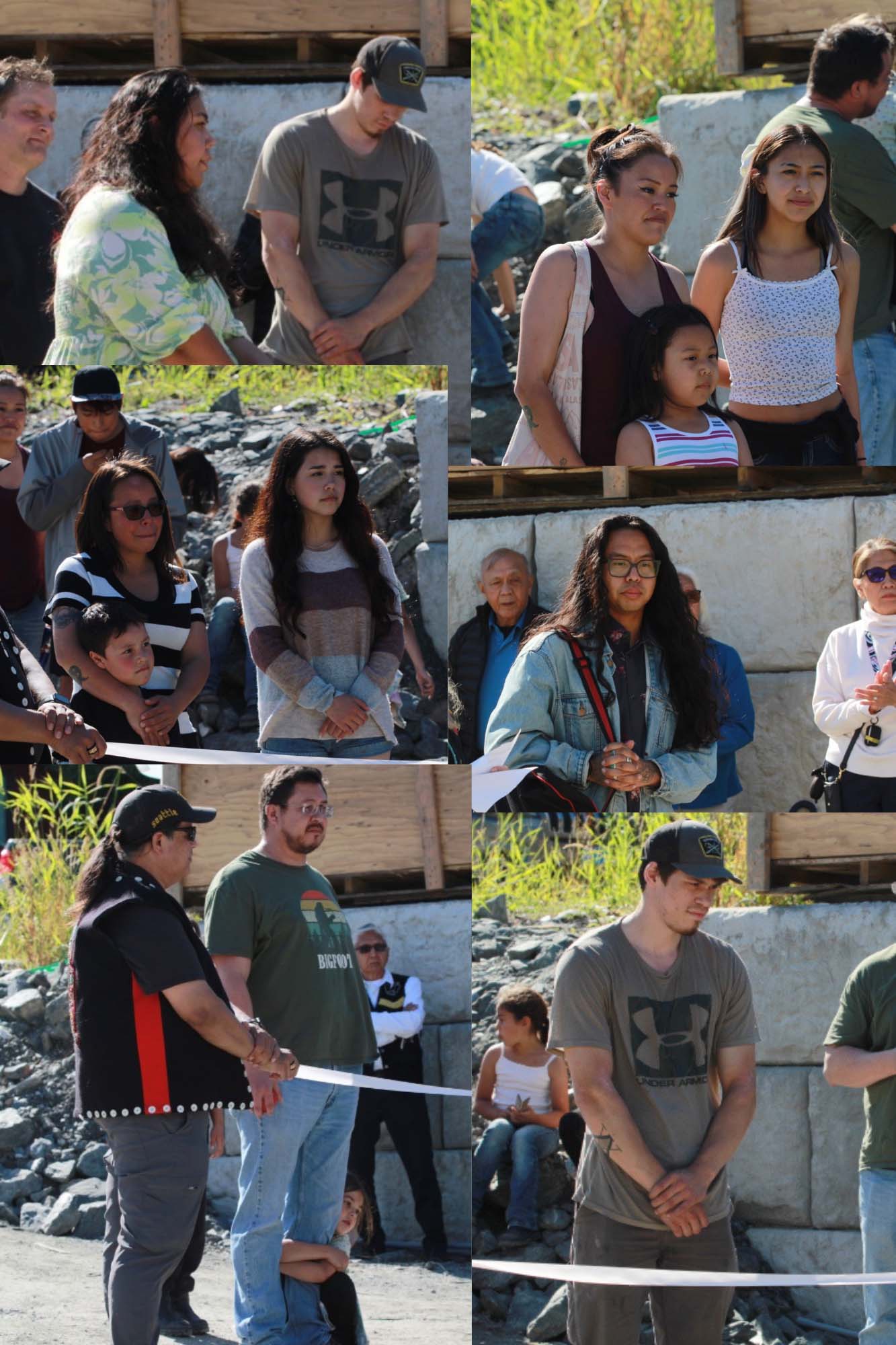
Crow Hill Ribbon Cutting – Celebrating Six New Tribal Homeowners

On Thursday, August 28, 2025, the Douglas Indian Association (DIA), Tlingit Haida Regional Housing Authority (THRHA), and Haa Yakaawu Financial Corporation (HYFC) came together to celebrate a milestone for our community: the ribbon cutting ceremony for six new homes at the Crow Hill development site in Juneau.

The event opened with a welcome from Jackie Pata, followed by Douglas Indian Association leaders Barbara Cadiente-Nelson and Andrea Cadiente Laiti, who shared the history of DIA and the importance of Tlingit homes in Douglas. Their words reminded us that this project is not just about housing—it is about cultural continuity, community strength, and honoring the vision of our ancestors.

As part of the ceremony, Paul Marks offered a blessing with devil’s club, giving each homeowner this powerful medicine. Devil’s club, long known in Tlingit culture as “good medicine,” was presented to provide peace, prosperity, and protection for each person who will live in these homes.

The program continued with the ribbon cutting, introductions of the homeowners, and traditional Raven and Eagle songs, marking this day as a true cultural and community celebration.

🏡 Homeowner Stories

  • Joseph Marks – From graduate student to professor, Joseph balanced a Master’s degree, full-time work, and now a PhD program in Sitka. As he steps into a faculty role at UAF, this home gives him stability as he begins shaping the next generation of Alaskans.
  • Robert Sharclane – A single father of three daughters and counselor at Gastineau Human Services, Robert created a safe and stable foundation for his family, showing resilience and dedication to his girls’ future.
  • Christina Kadake – A single mom of three, Christina partnered with HYFC’s financial counseling team, paid off all her debts, and even earned a promotion at IGA Foodland. Today, she stands proudly as a debt-free homeowner.
  • Amanda Bagoyo – A single mom of two and longtime employee at Catholic Community Services, Amanda not only saved diligently but also learned hands-on construction skills while helping with her home’s insulation. Her story reflects persistence and strength.
  • Jonah Davis – An electrician with Tongass Electric, Jonah contributed his skills to many THRHA projects—but this time, he helped build his own home. His journey has come full circle as he prepares to start a family in a house he helped construct.
  • Anna Larue – A SEARHC employee of 19 years and single mom of four, Anna waited patiently for this moment. With strong credit, savings, and a legacy of perseverance, she is now building generational stability for her children.

A Community Effort

This project is the result of strong partnerships between Douglas Indian Association, THRHA, and HYFC, with support from key funders who helped provide gap financing. Each home represents stability, equity, and a lasting investment in future generations.

Looking Ahead

As we welcomed the six new homeowners into their homes, we celebrated more than just construction—we celebrated lives being transformed, families being rooted, and dreams becoming reality.

Gunalchéesh / Háw’aa to everyone who helped make this possible.

by eme eme

PUBLIC NOTICE OF INTENT TO REQUEST RELEASE OF FUNDS

NOTICE OF INTENT TO REQUEST RELEASE OF FUNDS

September 5, 2025

Central Council of Tlingit Haida Indian Tribes of Alaska

9097 Glacier Hwy Juneau AK 99801

(907)586-1432


On or about September 15, 2025 the Central Council of Tlingit Haida Indian Tribes of Alaska and subrecipient, Tlingit Haida Regional Housing Authority will submit a request to the U.S. Department of Housing and Urban Development (HUD) for the release of Healthy Homes Production, Lead Hazard Reduction, Radon Testing and Mitigation Grant Program funds under the Consolidated Appropriations Act, as amended, to undertake the following multi-year program/project for the purpose of improving the Housing Quality Standards, eliminating deficiencies in structural, electrical, plumbing, heating, ventilation, insulation, rot and other areas such as asthma triggers.   Priority will be given to low income, elders, homes with children under 6 years old and emergency conditions in twelve Southeast Alaska Communities: Angoon, Craig, Douglas, Juneau, Klawock, Kake, Kasaan, Saxman, Skagway, Petersburg, Wrangell, and Yakutat, by addressing health and safety hazards in their homes with in-kind repair and rehabilitation to improve multiple single-family housing units throughout THRHA service areas. The project does not include demolition of existing sites or new construction.

The Central Council of Tlingit Haida Indian Tribes of Alaska and subrecipient, Tlingit Haida Regional Housing Authority is requesting the release of $2,000,000.00 AKHHP0149-24 and $200,000.00 NAHASDA / IHBG: 55IH0216230 matching funds FY2025 to FY2028.

Total estimated funds of $2,200,000.00. Grant Period: Maximum of 48 Months

The proposed hazard controls under the Healthy Homes Production grant will address the: Lead-Based-Paint Hazard, Radon Testing and Mitigation activities to be funded under this/these program(s) is/are categorically excluded from the National Environmental Policy Act requirements, but subject to compliance with some of the environmental laws and authorities listed at § 58.5 of 24 CFR Part 58. In accordance with §58.15, a tiered review process has been structured, whereby some environmental laws and authorities have been reviewed and studied for the intended target area(s) listed above. Other applicable environmental laws and authorities will be complied with when individual projects are ready for review. Specifically, the target area(s) has/have been studied and compliance with the following laws and authorities has been achieved in this Tier 1 review:  Airport Hazards, Coastal Barriers Resources, Air Quality, Coastal Zone Management, Contamination and Toxic, Endangered Species, Explosive and Flammable Hazards,  Farmlands Protection, Floodplain Management, Noise Abatement and Control, Sole Source Aquifers, Wetlands Protection, Wild and Scenic Rivers and Environmental Justice). Site-specific environmental reviews will include compliance with the following environmental laws and authorities for proposed projects funded under the program(s) listed above: (Flood Insurance, Historic Preservation, Contamination/Toxic Substances. Should individual aggregate projects exceed the threshold for categorical exclusion detailed at §58.35(a), an Environmental Assessment will be completed and a separate Finding of No Significant Impact and Request for Release of Funds published. Copies of the compliance documentation worksheets are available at the address below.

An Environmental Review Record (ERR) that documents the environmental determinations for this project, and more fully describes the tiered review process cited above, is on file at Central Council of Tlingit Haida Indian Tribes of Alaska 9097 Glacier Hwy Juneau AK 99801 and subrecipient, Tlingit Haida Regional Housing Authority 5446 Jenkins Drive Juneau, Alaska 99801 and may be examined or copied weekdays 8:00 a.m. to 4:30 p.m.

PUBLIC COMMENTS

Any individual, group, or agency may submit written comments on the ERR to the Central Council of Tlingit Haida Indian Tribes of Alaska, 9097 Glacier Hwy, Juneau, AK 99801 and to subrecipient, Tlingit Haida Regional Housing Authority, 5446 Jenkins Drive, Juneau, Alaska 99801. All comments received by September 15, 2025, will be considered prior to authorizing submission of a Request for Release of Funds and Environmental Certification to HUD.

RELEASE OF FUNDS

The Central Council of Tlingit Haida Indian Tribes of Alaska certifies to HUD that Richard J. Peterson, in official capacity as Tribal President, CCTHITA, consents to accept the jurisdiction of the Federal Courts if an action is brought to enforce responsibilities in relation to the environmental review process and that these responsibilities have been satisfied. HUD’s approval of the certification satisfies its responsibilities under NEPA and related laws and authorities and allows the Central Council of Tlingit Haida Indian Tribes of Alaska to utilize federal funds and implement the Program.

OBJECTIONS TO RELEASE OF FUNDS

HUD will consider objections to its release of funds and the Central Council of Tlingit Haida Indian Tribes of Alaskacertification for a period of fifteen days following either the anticipated submission date (cited above) or HUD’s actual receipt of the request (whichever is later) only if the objections are on one of the following bases:  (a) that the Certification was not executed by the Certifying Officer of the Central Council of Tlingit Haida Indian Tribes of Alaska; (b) the Central Council of Tlingit Haida Indian Tribes of Alaska has omitted a step or failed to make a decision or finding required by HUD regulations at 24 CFR Part 58; (c) the Central Council of Tlingit Haida Indian Tribes of Alaska has committed funds or incurred costs not authorized by 24 CFR Part 58 before approval of a release of funds by HUD; (d) another Federal agency acting pursuant to 40 CFR Part 1504 has submitted a written finding that the project is unsatisfactory from the standpoint of environmental quality.  Objections must be prepared and submitted in accordance with the required procedures (24 CFR Part 58), and may be addressed to HUD and sent to the email address as follows: OLHCHHPECOS@hud.gov   Potential objectors may contact HUD directly to verify the actual last day of the objection/comment period.

Richard J. Peterson

Tlingit &Haida Tribal President

CCTHITA (RE) Certifying Officer

AKHHP0149-24_NOI-RROF_NOFO final v2

by eme eme

Public Notice: THRHA Model Plan for Low-Income Home Energy Assistance Program (LIHEAP) FY 25 Grant

Public Notice

Tlingit Haida Regional Housing Authority (THRHA) is seeking comments from the public for the following proposed program:

Program Name:

THRHA Model Plan for the Low-Income Home Energy Assistance Program (LIHEAP) FY 25 Grant

Program Description 

THRHA is providing the draft program implementation for FY 25 grant funds to continue provide LIHEAP assistance to the following tribal communities:

Angoon Ketchikan
Craig Klawock
Douglas Klukwan
Haines Metlakatla
Hoonah Pelican
Hydaburg Petersburg
Juneau Saxman
Kake Wrangell
Kasaan

The entire draft plan is available on this link https://www.regionalhousingauthority.org/category/public-notices/

or by requesting a copy from THRHA at 907-780-6868 or reviewing at 5446 Jenkins Drive, Juneau, AK 99801.

Please submit all comments, questions, or concerns by August 1, 2024 at 4:30 PM to email energy@thrha.org or mail to 5446 Jenkins Drive, Juneau, AK 99801.

LIHEAP Model Plan FY 25-Draft
by Randy Randy

Tlingit Haida Regional Housing Authority Receives $2 Million Award to Create Access to Homeownership on Tribal Lands

Housing Affordability Breakthrough Challenge by Enterprise Community Partners and Wells Fargo names six winners out of over 400 applications from across the U.S. JUNEAU, Alaska.

Enterprise Community Partners (Enterprise) and The Wells Fargo Foundation today named Tlingit Haida Regional Housing Authority one of the six winners of the Housing AffordabilityBreakthrough Challenge, a nationwide competition to find and seed innovative housing solutions across the U.S. In addition to the grant funding, the six winning organizations will receive support from peersand industry experts to scale new strategies aimed at making homes more accessible.

Tlingit Haida Regional Housing Authority’s Success Starts with Me innovation is a new housing model which bridges the gap between traditional mortgage loans and the financial needs in rural SoutheastAlaska to provide low-income tribal citizens access to homeownership on tribal lands. Partners including Haa Yakaawu Financial Corporation will offer construction and home loans with individualized down payments, payback schedules, and education courses with the goal of supporting more than 100 families in the Juneau region.

“Winning the Housing Affordability Breakthrough Challenge will help us do more than build affordablehomes,” said Jackie Pata, president and CEO of Tlingit Haida Regional Housing Authority. “We’re actually trying to change what the future will be for the next generation. Remote rural villages need to have the same kind of opportunities that urban America has.”

The competition drew more than 400 applications from a wide range of innovative nonprofit and mission-driven for-profit organizations stretching from Florida to Alaska in three categories: Access andResident Support, Construction, and Financing. After two application rounds, 16 finalists were invited to present their innovations in a 10-minute pitch to a panel of judges composed of national affordable housing and community development experts, including leaders from Wells Fargo and Enterprise.The other competition grant winners are: : Build UP, Grounded Solutions Network, Hope EnterpriseCorporation, Hydronic Shell Technologies, and Module.

“There is incredible demand across all types of communities for affordable housing solutions that aretailored to local needs and have the potential to scale,” said Jacqueline Waggoner, president of theSolutions Division at Enterprise Community Partners. “The Housing Affordability Breakthrough Challengeenables leaders on the ground to multiply their impact nationwide. We are so excited to work with thissecond cohort of winners to bring their ideas to the next level.”

“Creating true equity in the nation’s housing system requires a focus on transformative ideas thatchallenge current housing practices and processes,” said Stacy Spann, head of Housing Access andAffordability Philanthropy at the Wells Fargo Foundation. “Through the Housing Affordability Breakthrough Challenge, we are intentionally lifting up solutions to serve communities that have experienced disinvestment and marginalization for far too long. And the winning group of entrepreneursand social innovators truly combine expertise with the lived experiences of the communities we aim toserve.”

The 2023 winners will take part in a multi-year peer learning network to share ideas and cultivate their innovations into solutions that can be applied to communities across the U.S. The cohort will gain accessto a network of leaders from across the housing sector, including experts from Enterprise and pastwinners of the competition.

For more information on the competition, as well as the finalists and their winning proposals, visit the Housing Affordability Breakthrough Challenge website.